A FlowState project · A speaking instrument for one
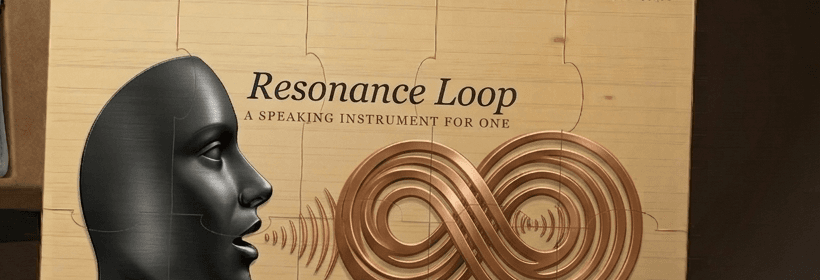
A teleprompter that becomes a speech editor, a delivery coach, and a Speaking DNA that learns from every speech you give.
A note from J
I built Resonance Loop because I give a lot of speeches and almost none of them ever come back to me as data. I read the script the night before, deliver it the next morning, and the feedback I get is whatever someone tells me at the coffee station after. That is not feedback. That is theater.
The instrument is small on purpose. Paste a script. Read it through a teleprompter. Record yourself. Get six panels of signal and one paragraph that names the pattern. Do it again next week and the system starts noticing what carries.
The pilot is free. The plan is to keep it free until the data tells us whether the format works. I am inviting five to ten speakers I trust to break it in. If you got this far, you are probably one of them.
J
Find the resonance insights
Six statements the inspector might hand you about your own delivery.
The reframe
Speech is not performance.
Most speakers treat speech as performance, a thing you put on and get through. The signals that determine whether the speech actually carried disappear with the moment. Resonance Loop treats speech as calibration, with a reference, a measurement, and an adjustment.
What that means
When an engineer calibrates an instrument, they tune it to a known reference, observe what the measurements say, and adjust. The same loop runs here: your script is the reference, the inspector reads the measurement, the next speech is where the adjustment lands.
When the practice becomes calibration rather than performance, the work compounds, and every speech is one turn in a longer practice.
What it does
Cadence is the carrier.
Cadence is what carries meaning across the room. Every speaker has a personal range, and most speeches drift outside that range in the third quarter without the speaker noticing. The drift is what costs you the room.
The body parallel
Heart rate variability tells you whether the body is recovering or accumulating stress, and cadence variability tells you whether the speech is opening up or tightening. A steady center plus deliberate movement, with the drift zones surfaced after the fact.
The principle
The 90-second beat.
The 90-second beat is a pacing principle drawn from keynote work. Each beat opens with a claim, lands with one example, and closes with a turn. Three beats fill a four-minute opening; ten beats fill a fifteen-minute talk.
What lives inside a beat
Hook, evidence, turn, landing, silence, recovery. The shape repeats. The instrument that watches your beats is the one that lets you stretch them, on purpose, when the room asks for it.
The instrument that watches your beats is the one that lets you stretch them on purpose, when the room asks for it.
The principle
Warmth and structure, in the same breath.
Speech that lands holds two registers at once: warmth that names the audience as people who already do hard work, and structure that gives them clear claims with clear next moves. Either register alone collapses the talk.
The diagnostic
A leader who is all warmth and no structure abandons the room, and a leader who is all structure and no warmth controls it. The instrument shows you which side of the line your delivery sits on, paragraph by paragraph, so the correction is local rather than global.
What it is
The drift you cannot hear.
Drift is the slow, quiet way a speech walks away from itself. The cadence drops, the structure dissolves, the framework you set up at minute two is forgotten by minute fifteen, and you cannot hear it from inside the speech.
What the inspector sees
Verbatim on the left, paraphrased through the middle, skipped on the right. The shape of a speech that walked away from itself, surfaced after the fact so the next speech can hold its center.
Drift is the slow, quiet way a speech walks away from itself, and the only way to catch it is to read the signal afterwards.
The shape
Six panels of signal, after every speech.
After every recording, the inspector hands you six panels: cadence, voice level adherence, framework fidelity, audience carry, drift map, and pattern across speeches. The panels are mostly silent until they have something to say.
What each panel watches
Cadence
Words per minute by 30-second window, with drift zones marked.
Voice level adherence
Where your delivery held the level you set, paragraph by paragraph.
Framework fidelity
How closely the delivery tracked the frameworks you applied.
Audience carry
Where you stopped to let a line land, and how long the silence held.
Drift map
Where the delivered speech diverged from the script you wrote.
Pattern across speeches
What the Speaking DNA noticed once you had given more than one speech.
Six panels are not six metrics; they are six different angles on the same speech, the way a good coach watches the same player from six different angles before saying a word.
Six frameworks, ready on day one.
The editor and the inspector both run frameworks against your speech. Six ship with the instrument from the first sign-in: Parable Structure, High Warmth and High Structure, Agency Triangle, the 90-second beat, Recovery-Based Accountability, and the Sonic Spiral. If you already work with a framework that is not on this list, you can paste it into your settings, the system will sanitize it, and the editor will apply it the next time you transform a script. The frameworks you build over time are part of your Speaking DNA.
Framework
Parable Structure
Initial state, apparent fortune or misfortune, conventional response, alternative perspective, fortune reverses, cycle continues.
Framework
High Warmth + High Structure
Audible quality. Warmth without structure is abandonment. Structure without warmth is control.
Framework
Agency Triangle
Three vertices of high-agency leadership: Control, Influence, Release.
Framework
The 90-Second Beat
Pacing principle from the keynote work.
Framework
Recovery-Based Accountability
Standard, drift, recovery, inspection.
Framework
Sonic Spiral
Cross-speech learning pattern. The Speaking DNA file is its operational form.
Join the pilot.
Five to ten speakers, free for thirty days. The first speech is the one you give next, and the instrument starts learning your patterns from there. After thirty days we will know whether the format is right; either way the data we gather together teaches the next version.